


Key takeaways
- Unmanaged, off-platform travel bookings generate massive administrative shadow work. This costs US businesses $564 billion annually, and causes budget leakage through missed corporate rates, expired airline credits, and lost tax reclaims.
- When business travelers book through consumer channels rather than central platforms, finance teams lack real-time spend visibility and are forced to manage travel budgets reactively.
- Itineraries across multiple apps make it difficult to track or assist employees during emergencies and travel disruptions.
- Navigating disconnected tools increases travel stress and data entry errors. Consolidating travel processes streamlines administrative workflows for both travelers and finance teams.
For many companies, allowing employees to book their own flights on consumer sites, or reserve hotels and arrange car rentals through third-party platforms, feels like offering flexibility. It can even give the illusion of saving money by shopping around.
However, this approach brings with it significant shadow work, the unseen drain on time, budget, and resources from avoidable admin tasks. That work costs US companies $564 billion per year.
According to Deloitte's 2025 Corporate Travel Study, only 49% of business travelers use corporate channels, meaning the majority still book off-platform or through unmanaged channels. With multiple bookings across different systems, work travelers can quickly struggle to stay organized, while travel managers are left with visibility blind spots. When plans change unexpectedly, this impacts cost tracking, safety, and the ability to provide support.
This article looks at the huge potential impact of these seemingly small inconveniences, and how consolidating travel itinerary management into a single, unified platform is becoming essential for modern business travel.
The financial impact of fragmented travel management
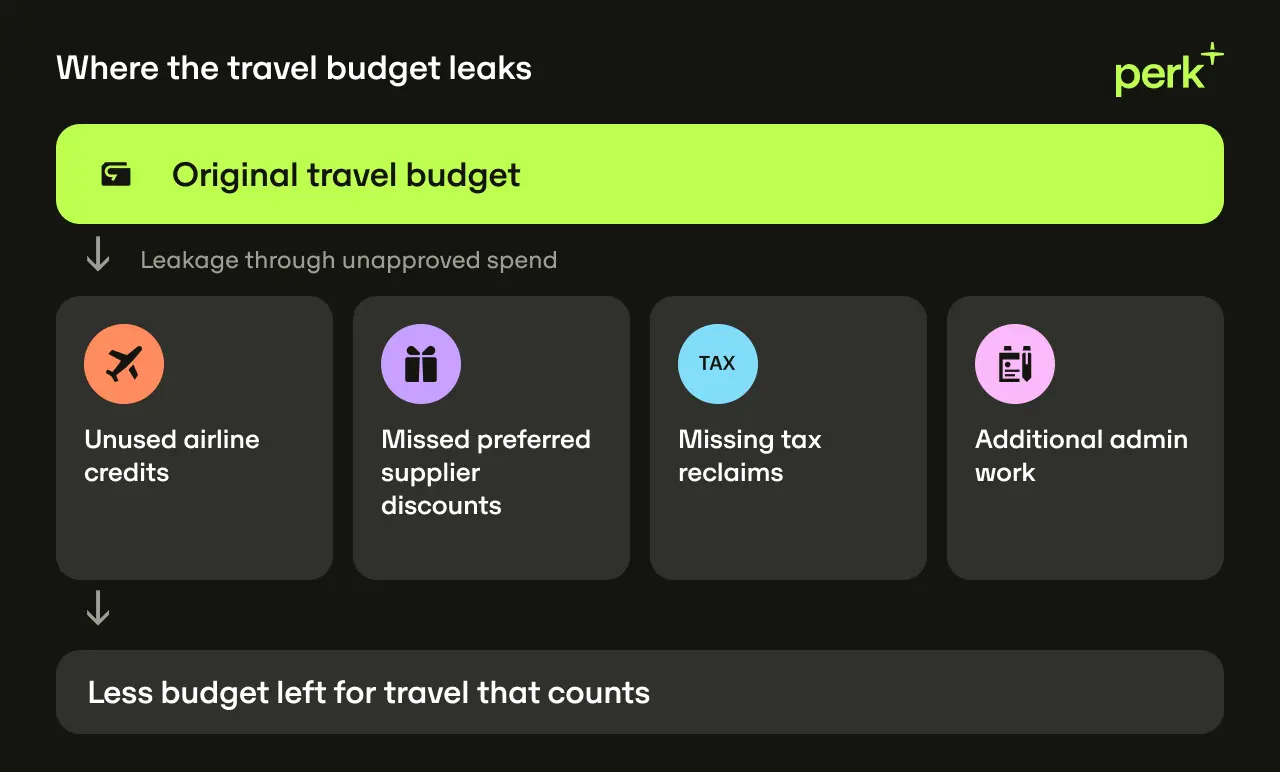 When bookings are made outside of a centrally-managed system, the most immediate issue is often financial.
Transactions made outside of official booking tools are not as likely to be checked against policies on budget, purchase type, or preferred suppliers. Worse still, transactions may not be noticed until weeks after a trip is over. This ‘leakage’ can use up a hugely significant percentage of the overall travel budget and is widespread.
Industry research from the Global Business Travel Association found that 67% of travel managers report air travel leakage increased or remained flat, while 81% reported the same for hotel leakage.
Pricing of unstandardized fares
When employees book travel independently using commercial services, apps or directly with airlines, they might think they are acting in the best interest of their employer by finding the cheapest possible deal. They are likely to be unaware of negotiated corporate rates and bulk discounts that may be in place with preferred suppliers, and could actually be increasing the cost of travel by shopping around.
Dynamic pricing also means that two people traveling to the same conference could pay significantly different prices for the same flight or hotel due to their booking method.
Missing invoices and tax compliance
Fragmented travel booking leaves finance teams chasing partial receipts and reconciling with personal credit card statements to piece together an individual’s travel expenditure.
Without the correct tax receipts that meet IRS compliance standards (such as required documentation for expenses exceeding $75), companies could be unable to claim tax deductions, state sales tax credits, and international VAT reclaim they should otherwise be eligible for, adding avoidable tax penalties to every incomplete transaction.
"A cheaper booking doesn't always mean a cheaper work trip. When finance teams spend hours tracking down receipts and reconciling expenses, those savings can disappear quickly. You have to look at the cost of managing the entire trip, not just the ticket price."
Vicki Williams, VP of Sales, UKILack of analysis
When portions of booking data are siloed in personal accounts, it becomes impossible to accurately review trends in spending, manage department budgets, or accurately forecast for future business travel.
In these situations, finance teams have no choice but to operate reactively after money has already been spent, rather than having the flexibility of proactively managing spend in real time.
The productivity impact of fragmented travel management
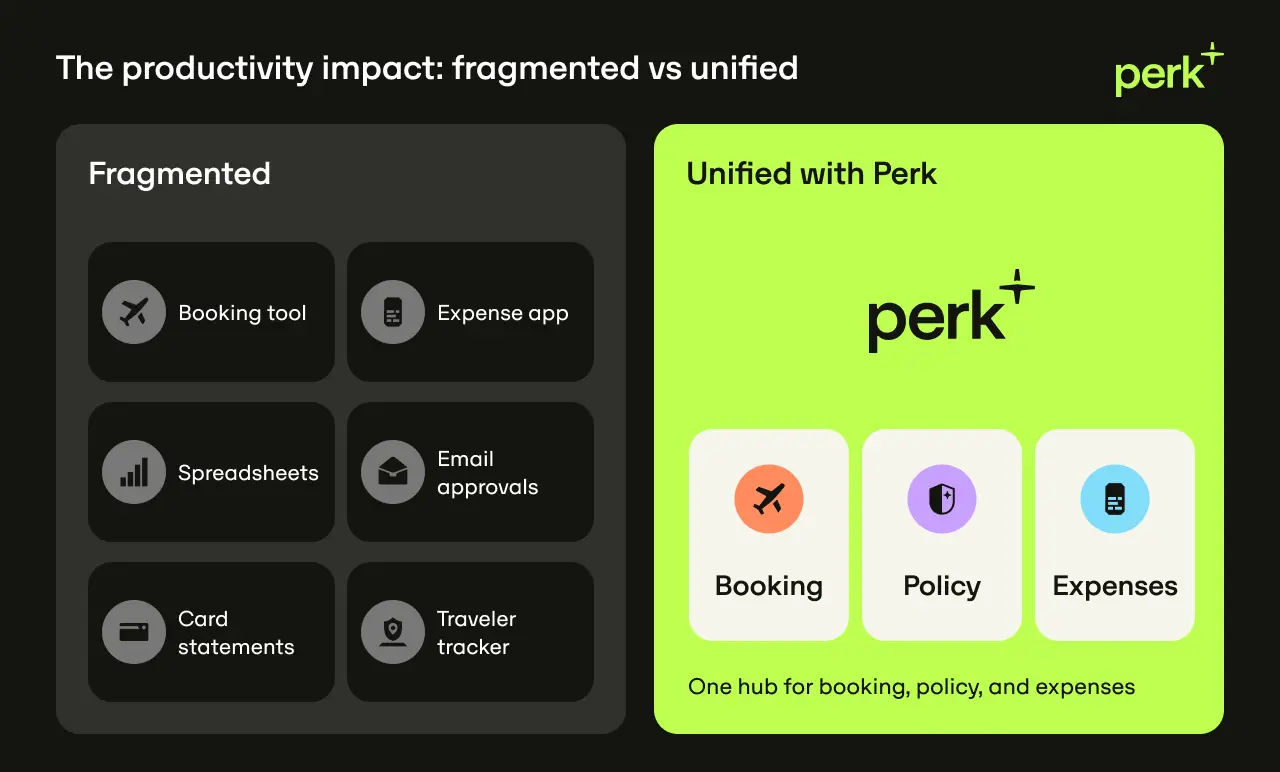 Managing travel across disconnected applications creates an avoidable operational burden on both finance teams and travelers.
Managing multiple tools and apps
Fragmentation of a single work trip could see employees navigating multiple applications, for example:
Email inboxes
Airline apps (Delta, United, American)
Hotel brand portals
Rental car & ride-share accounts (Uber, Lyft, Hertz)
Expense reporting tools
Security pass apps (TSA PreCheck)
Increased risk of manual error
When systems are fragmented, the connection between them is human and manual entry naturally results in an increased error rate compared to an integrated platform.
A single typo can affect arrival dates and times, expense amounts and other mistakes that could take hours to identify and resolve.
The human impact of fragmented travel management and duty of care
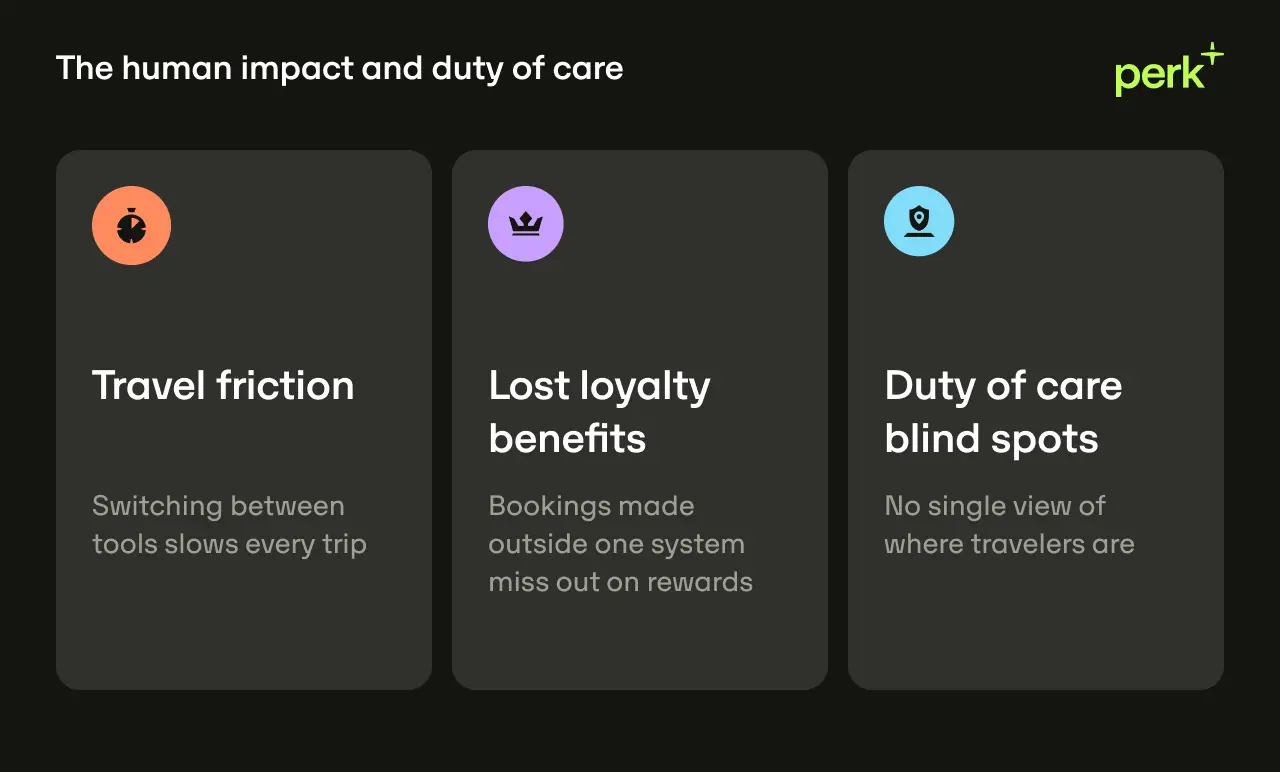 A fragmented approach to travel itineraries doesn’t just hurt the bottom line and increase shadow work. It can also directly affect the well-being and safety of the traveling individuals and make meeting duty of care requirements difficult.
Avoidable friction during travel
Modern employees are used to fast, digital-first experiences in most aspects of their life. Being forced to search through emails for a reference number while in line for airport or hotel check-in adds an unnecessary level of stress to what should be a straightforward process.
Loss of personal loyalty benefits
When bookings are made through consumer third-party companies, company benefits, room preferences, and loyalty points could all fall through the cracks.
Using a travel management platform that allows pass-through payments can prevent this by allowing travelers to keep their credit card and loyalty points while also allowing their company’s team to maintain full oversight over compliance and payment tracking.
Duty of care blind spots
While there is no specific duty of care law in the US, employers have a legal and ethical responsibility to comply with the OSHA General Duty Clause and other federal regulations to ensure the safety and well-being of their teams when they are on the road for work travel.
If severe weather, travel disruptions, or security emergencies were to occur, knowing where employees are is vital for safety and support.
When bookings are fragmented, blind spots on the itinerary are created. As the HR team will not know if the individual checked in for their flight or has arrived at their destination, this makes it difficult to locate or assist with revised bookings to minimize disruption.
"When a flight gets canceled or something unexpected happens, travel teams need to know where their people are and how to help them. That's much harder when bookings are scattered across different platforms. Bringing travel information together gives teams a clearer picture and helps them respond faster when it matters."
Vicki Williams, VP of Sales, UKIThe benefits of a unified travel platform
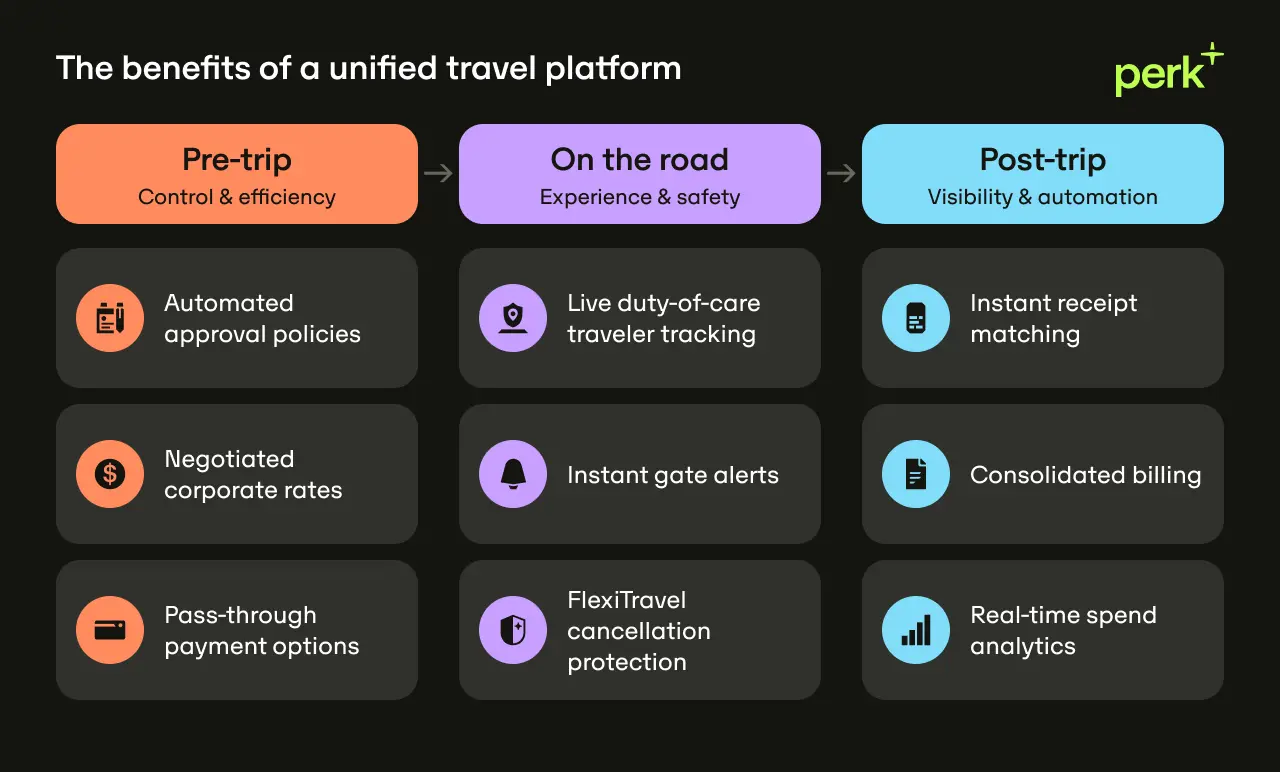 Moving away from a fragmented system does not have to mean sacrificing traveler flexibility. Switching to an all-in-one travel management platform like Perk gives companies transparency and visibility over the entire travel itinerary and travel logistics, while making the experience as simple as possible for work travelers.
Centralized search, booking, and approvals
A consolidated travel platform combines bookings and invoicing for flights, stays, and ground transportation into a single, central dashboard. Budgets and policies are built in, automatically managing approvals and helping individuals to book their own stays or transport within these parameters.
Real-time spend visibility and financial automation
As all billing is gathered centrally, expense matching can be completed automatically. Real-time analytics allow for instant decision-making to pivot and revise plans quickly if the original itinerary needs to adjust due to delays or revised plans.
A seamless traveler experience
Rather than multiple tools, travelers can manage their entire trip’s itinerary in a single app. Changes, such as revised travel plans and departure gates, can be pushed to their app directly. If more help is needed, Perk also provides 24/7 Customer Care.
FlexiTravel provides even more reassurance, allowing travelers to cancel a flight or hotel booking up to 2 hours before departure and recover at least 80% of the cost as travel credit.
"Travelers want the freedom to book trips that work for them. Finance teams need visibility and control. There's no reason businesses should have to choose between the two. When booking, travel policies, and expenses work together in one platform, employees get a simpler experience and finance teams can spend less time chasing information - helping to reclaim the 7 hours a week the average employee currently loses to manual admin tasks."
Vicki Williams, VP of Sales, UKICommercial tools vs unified travel management platforms
Feature | Standalone consumer tools (e.g., TripIt) | Unified travel platform (Perk) |
Itineraries | Manual management across platforms. | Automatic. Bookings are all visible on a central dashboard in real-time. |
Policies and approval | No enforced limits. | Automatic. Custom policies can be applied before transactions are made. |
Expenses | Requires manual exports or a third-party app. | Automatic. Transactions are matched with receipts automatically. |
Duty of care | Minimal tracking capabilities. | Live map. Track trip progress globally with risk alerts. |
Support | Would need to contact individual airlines or suppliers. | 24/7 Customer Care. Instant access to support agents who can rebook trips directly. |
Flexibility | Would need to contact individual airlines or suppliers for cancellation policies. | FlexiTravel. Cancel flights or hotels up to 2 hours before departure. |
Take control of your travel management process
Fragmented travel itinerary management is a significant overhead that only provides the illusion of ease and flexibility. Reliance on multiple consumer portals leaves travel management teams and business travelers scrambling to avoid mistakes that could see flight credits lost, tax reclaims missed, and hours of additional, stressful, avoidable admin.
By consolidating bookings, policy controls, payments, and itinerary management into a single intelligent platform, the business travel experience becomes simpler and safer.
Discover how to create a business travel itinerary that keeps your team organized, safe, and focused on doing great work. Then book a demo to see how Perk can transform your approach to travel management.
Written by

Product Marketing Manager