


Key takeaways
- Unrestricted self-booking can generate shadow work and compliance risks. Meanwhile, giving employees freedom to book on consumer sites improves job satisfaction but also creates fragmented receipts, out-of-policy spend risks and duty-of-care blind spots.
- Traditional fully managed travel enforces control at the expense of flexibility, which can frustrate workers who want control over their work travel itineraries.
- Modern work travel succeeds when organizations pair employee flexibility with automated policy guardrails, creating a balanced framework that allows for reduced administrative friction without sacrificing duty of care.
Most workers want the freedom to book their work travel in the same way that they approach personal trips, choosing what they need to make their journey comfortable and convenient. However, finance and operations teams need strict policy control and clear spend visibility, which doesn’t exactly align with the flexibility that traveling colleagues desire.
Fortunately, businesses don’t need to choose between total employee autonomy and rigid centralized management. In this article, we’ll explore how modern corporate travel platforms deliver employee flexibility alongside automated compliance monitoring.
The case for employees booking their own travel
By letting team members book their own travel, teams have autonomy over their schedules, increasing employee satisfaction and reducing friction. Here’s how:
Convenience and quickness
As an employee, waiting for your travel manager or an external booking agent to book a simple flight or a hotel stay can feel clunky and slow. When workers book their own travel, they can select their preferred flight times and hotel locations, meaning they can move forward with planning their work travel activities.
On-the-go flexibility
We know that business trips can change at the last minute. If a flight gets canceled, a project runs over, or a client meeting moves, it can trigger a paperwork nightmare when an employee has to contact the central office to rearrange plans. If travelers can make those changes on the fly, arrangements can be changed quickly without involving other stakeholders.
Job satisfaction
Professionals want to be treated like adults at work, and this extends to travel. Autonomy with travel can make the difference between an employee who feels untrusted and one who feels empowered to make decisions for themselves. Deloitte’s study on workplace experience shows that factors like trust are central to job satisfaction.
By giving people autonomy in their work travel arrangements, workers are likely to feel more respected than having to go through a rigid approval flow that leaves them feeling like they aren’t trusted.
Unrestricted employee travel booking - the risks
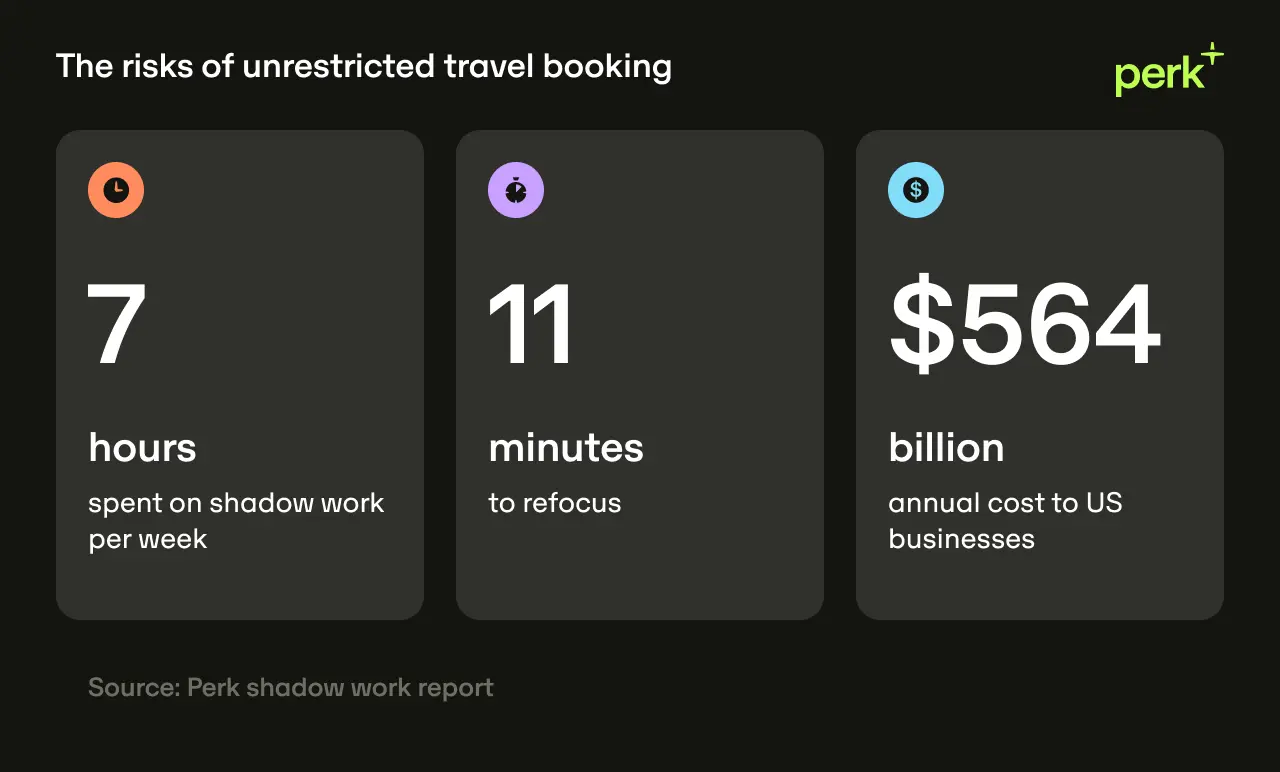 So, giving your workforce the freedom to book their own work travel seems like an obvious choice, right? Sadly, it’s not that simple when it involves colleagues searching on standard consumer websites with no restrictions at all. Let’s take a look at some of the risks of unrestricted self-booking.
Managing the paper trail
If workers book their own travel without any guardrails in place, several elements of this process may introduce extra work:
People may use their own personal cards to book their travel.
Workers may book with multiple providers to book different elements of their trip, creating multiple transactions and receipts.
This creates a stream of invisible tasks: chasing receipts, manually filing expense claims, and managing reimbursements. This is shadow work, the non-core tasks that distract employees from their actual jobs, and it costs businesses in the US $564 billion every year, according to The Cost of Shadow Work report, a Forrester Consulting study sponsored by Perk.
Scenario
Jack needs to travel from Chicago to attend a client meeting in Dallas, so he books his flight, hotel, and airport transfer separately on consumer sites, using his personal card because it’s much quicker than waiting for approval from company HQ.One week later, the finance team receives three different receipts from three suppliers, each with different tax details and booking references, making it a lengthy task to process them.Jack also accidentally booked a non-refundable room that exceeded the company’s usual rate cap, so the finance team had to spend time contacting him to remind him of the policy to prevent it from happening again.Out-of-policy spend
Independent travel booking may provide people with a sense of autonomy, but the result can be a lack of visibility for your finance team. Out-of-policy trips, such as flights with a carrier that doesn’t correlate with your negotiated corporate deals, become more probable and might not be noticed until weeks later. This kind of financial leakage is known as maverick spend. Research from the Hackett Group shows that organizations routinely lose between 10% and 20% of their targeted financial savings directly to maverick purchases.
Scenario
Carrie books a last-minute work flight directly on a consumer airline site, because it looks cheaper at checkout. She chooses a carrier that isn’t part of the company’s travel program, pays on her personal card, and adds a seat upgrade.The finance team spots the booking weeks later when the expense claim comes through, by which point the trip is already outside policy. The result is higher travel cost, hours of shadow work checking the trip against policy, and more work to query, approve, and reconcile the spend.Managing last-minute changes
While some might be absolutely fine with managing their own rebooking, cancellations, and refunds when plans change, others may find this stressful. It also risks pulling focus away from other key business priorities and the whole reason they’re on the trip in the first instance.
Scenario
John is halfway through a two-day client trip when the meeting is moved up by 24 hours, meaning he has to cancel his original hotel stay, rebook his return travel, and request a refund for a non-flexible train ticket.He spends a stressful evening comparing options, checking cancellation rules, and trying to recover costs instead of preparing for the rescheduled meeting.Potential duty of care issues
Employers have a legal responsibility to safeguard staff during work travel. While traveling, that airport lounge or hotel room is essentially an extension of the workplace and businesses must take reasonable and practical measures to reduce the risk of harm, as mandated by OSHA’s General Duty Clause and supported by global risk standards like ISO 31030:2021.
Without centralized tracking of itinerary data, bosses may struggle to reliably locate or assist staff during unexpected emergencies.
Scenario
David is traveling to a conference, but because he booked his hotel, flight, and train independently, his itinerary doesn’t get pulled into the company’s central travel record.When a local security alert hits during David’s journey, his manager can’t quickly confirm where he is, which hotel he’s staying in, or how to reach him.Is there a middle ground?
So far, we’ve learned that managing travel for businesses can introduce some challenges around control and flexibility. Traditional travel management systems can box companies into one of two options:
Fully managed
This encourages policy compliance and mitigates risk, but can frustrate colleagues who want more flexibility.
Self-booking
The most flexible option, but it can generate more shadow work, unmanaged risk and an out-of-control paper trail
A middle ground between these two options is a travel management platform like Perk, which allows self-booking for corporate travel within a managed framework. By letting workers choose their own travel itineraries within pre-set policy guardrails, companies can benefit from both employee autonomy and corporate control.
Using a modern travel management platform
Perk offers a combination of enterprise-level travel management control alongside booking simplicity that makes arranging travel as easy as using a consumer website. You no longer need to compromise on oversight or flexibility; with Perk’s features you can have the best of both worlds.
Freedom, but within automated guardrails
With a modern travel management platform, employees have an element of choice, while you retain overall control:
Employees have the flexibility to search for their own flights, stays, train travel and car rental, within an inventory of pre-chosen suppliers.
Pre-set travel policies apply automatically during searches, so people can only view or book options within your chosen limits, such as budget constraints or preferred hotel chains.
Centralized invoicing
Instead of the endless stream of chasing personal card receipts, Perk consolidates transactions into one clean interface. And automated receipt capture and tax recovery mean finance teams can save time by skipping manual reconciliation entirely.
Automated approvals
The manual process of approving trips is a thing of the past with instant approvals, set centrally by you. If an itinerary is non-compliant for any reason, automated approval workflows route the request to the designated manager immediately, reducing accidental spend leakage.
24/7 support when you need it
When the worst happens and a trip is disrupted, Perk provides 24/7 access to human travel experts with a target response time under one minute. That means fewer calls to head office and the traveler can get access to instant help.
Full visibility for travel and finance managers
Perk gives you a detailed oversight of travel spend, active itineraries, and even carbon footprints, all live within the Perk interface. Real-time data keeps budgets on track, makes reporting easier and frees up teams to focus on strategic planning.
The best of both worlds with Perk
You don’t have to choose between control and flexibility when it comes to managing work travel. With Perk, you can maintain full budget and compliance oversight with pre-set travel policies, centralized invoicing, and automated approvals, while your employees enjoy the freedom of shopping for a work trip within company limits.
Book a demo today to explore all of the options.
Written by

Product Marketing Manager
