


Key takeaways
- Set bleisure policy boundaries: HMRC guidelines require business and personal expenses to be split
- Duty of care doesn’t stop when leisure time begins
- Automate expense splits to make bleisure trips compliant
The lines between business and leisure are officially blurred, with the arrival of bleisure, where employees take a holiday at their work trip location once the business elements are over. It’s a popular way for people to make the most of being away for work, with 76% of SMEs saying that they extend their employees’ work trips to enjoy leisure time. 57% of those extend their trip by 1-2 days, and 32% by 3-4 days.
Bleisure feels like a win-win. For employees, it’s morale-boosting, and for employers, it means workers could be more likely to agree to business trips in the future. However, without a rigorous policy in place, companies can soon find themselves at a disadvantage. Managing each bleisure request on a case-by-case basis, deciphering business expenses vs personal ones and arranging open return travel options can become the kind of repetitive work that costs your business serious money. And that’s without considering the duty of care implications.
With bleisure becoming a permanent feature of work travel, this guide will help businesses remain flexible with work travel whilst protecting themselves from duty of care risks and time-consuming tasks that keep teams from impactful work.
"76% of SMEs extend their employees’ work trips to enjoy leisure time"
Source: Travel Counsellors for Business surveyWhat are the legal implications of allowing bleisure trips?
Despite the popularity of blended business and leisure travel, in the UK, there is no industry standard or legal framework to help businesses manage them. This is why it’s crucial for companies to create their own policies to protect employees and the business.
Tax deductibility
When it comes to HMRC rules, only the business parts of a trip are tax-deductible, and you must be able to prove this. When a trip mixes business and leisure, you cannot present the overall expense as tax-deductible.
So, under HMRC Business Income Manual BIM37600, you must demonstrate that "a definite part or proportion" of an expense is identified as wholly for business. A hotel stay for a 3-day sales conference is deductible, whereas an extra night for personal reasons is classed as leisure and cannot be expensed.
You also need to consider a strict start and end point. Reimbursable activities stop strictly when the business duties end. If a worker were to return home to collect more luggage, or check in to a different hotel for leisure purposes, this is a clear indication that the business part of the trip has ended.
Benefit in kind rules
If you decide to fund the leisure part of a worker’s stay, such as an extra few nights at a hotel or a spouse’s flight fare, HMRC are likely to class this as taxable “Benefits in kind” payment or BIK. There are some exceptions, which are detailed on the HMRC website.Legal liabilities
Even when a work trip turns into a personal holiday, the duty of care obligations of an employer don’t simply stop. In many cases, it may be safer to maintain your duty of care responsibilities for the entirety of a trip.
Here are some details to be aware of when it comes to your legal obligations:
The Health and Safety at Work etc. Act 1974 means employers have a legal duty to look after the health, safety, and welfare of employees, including on work trips.
The Corporate Manslaughter and Corporate Homicide Act 2007 came into force on 6 April 2008, and it holds organisations to account for manslaughter caused by gross negligence at work.
ISO 31030:2021 is the international standard for travel risk management and is a good place to start when planning safety policies.
Who pays for what on a bleisure trip?
How you decide to split a bleisure trip is down to your company’s individual policy, but it’s something you’ll want to define to avoid queries later down the line.
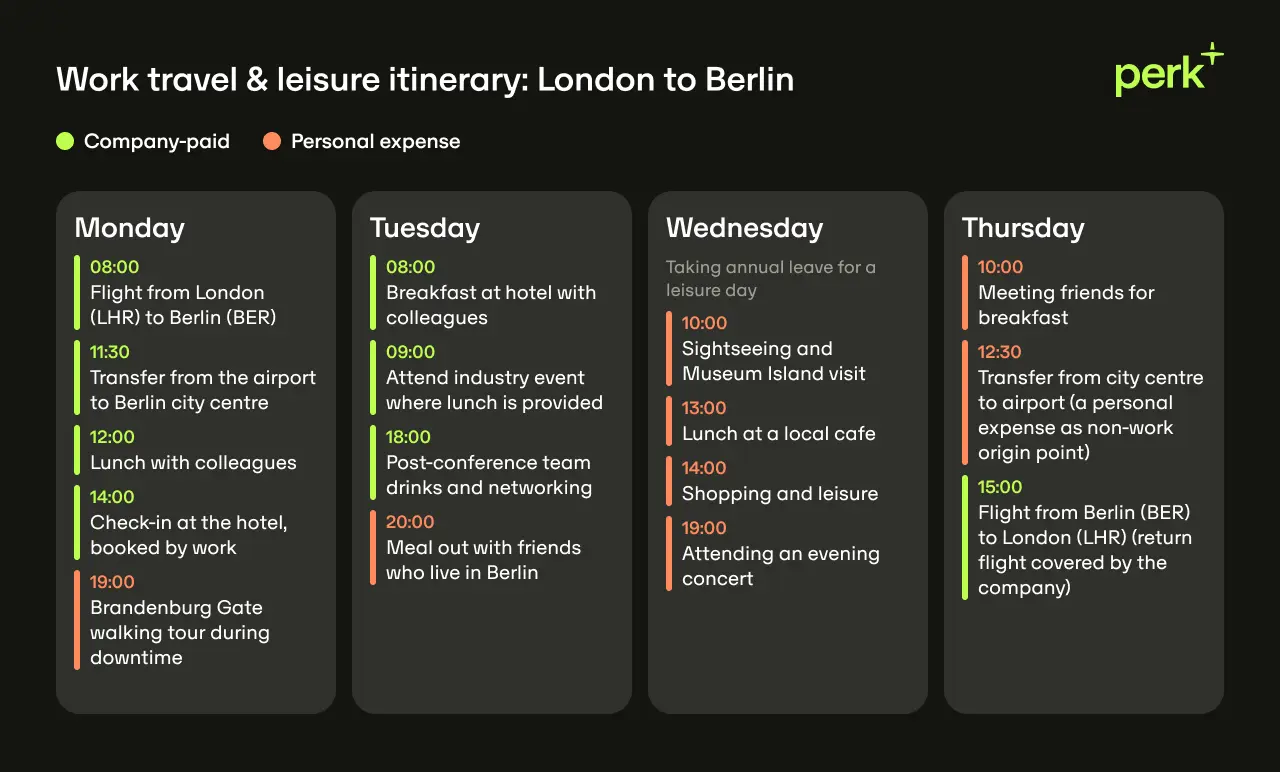
The simplest framework is to outline that the business will pay for what the trip would have cost as a business-only itinerary. Anything outside of that will need to be paid for by the employee.
Flights, trains and other primary transport
Firstly, establish what the flight would have cost for the business dates alone, and work from there.
If adding a personal extension doesn’t change the airfare or train ticket, the company should pay in full.
If extending the trip increases the fare, the employee should pay the difference.
For reporting reasons, you should document the price split at the time of booking, as it will be much easier than trying to analyse it later down the line.
Accommodation
If an employee wants to extend their stay at a hotel or rented apartment, the company should pay for the hotel nights required for active work days. Anything extra must be settled by the employee.
It’s at the company’s discretion, but corporate hotel rates can be used for personal stays.
Additional guests
This one is entirely the responsibility of the employee. Family members or other travel companions are personal expenses, not company ones.
How to set boundaries for bleisure trips
Keeping things straightforward and defined in a company policy is the simplest way to avoid confusion and keep everyone on the same page. Spending time defining explicitly where business obligations end and personal time begins will avoid confusion later down the line and allow employees to confidently split their work and leisure time.
The ‘Work Window’
When a business trip is going to be extended for pleasure, make it compulsory that explicit date and time boundaries are written into the itinerary. Define exactly which dates are part of the work trip, factoring in reasonable travel time before and after, and assign an end point. From then on, costs become personal expenses.
Itinerary disclosures
As we’ve outlined, duty of care responsibilities don’t end on work trips, even when financial liability does. Even when the company isn’t financially responsible for a portion of the trip, it’s crucial to still record the trip’s details centrally.
With a central booking tool, this information can be included within the itinerary before departure. It also means the employee remains connected to the company’s emergency alert systems for the whole trip.
To comply with UK GDPR law, ensure that this monitoring is disclosed within your central travel policy.
Reimbursable vs non-reimbursable expenses
With a bleisure trip, it’s even more important to make sure robust expense policies are in place, so teams know exactly what they can claim for, to minimise the risk of people unintentionally breaching company guidelines.
Reimbursable (Business Window) | Non-Reimbursable (Excluded) |
|---|---|
Airfare for business dates | Fare increases caused by personal date choices or class upgrades |
Standard hotel room for work nights | Hotel nights during personal extension days |
Business meals within company per diem | Sustenance and entertainment on leisure days |
Transport between airport, hotel, and work sites | Additional leisure trips whilst working, car hire extensions, or personal taxi rides |
Work Wi-Fi and calls | In-flight purchases, personal appointments, minibar, or spa services |
Mandatory baggage fees | Excess baggage for personal items such as sports items or a partner’s baggage |
Automating the bleisure split
Without some kind of automation in place, the manual process of managing these types of blended business trips can create endless shadow work for travel managers, who have to manually approve disjointed journeys and sort split invoices.
By embedding bleisure policy rules directly into your booking platform, a lot of the extra work created by blended work trips can be automated to ensure compliance:
Link bookings to expenses: configure your system so that bookings are automatically linked to expenses, which eliminates personal extension spend.
Set up smart card controls: consider issuing virtual cards with pre-set limits on budgets and merchant categories. This ensures that the company pays for business expenses only, whilst leisure expenses will be automatically blocked.
Use traveller tracking: maintain duty of care visibility by using traveller tracking across all legs of the journey.
Bleisure Policy Audit Checklist
Is your current corporate travel policy suitable for bleisure trips? Follow this checklist to make sure your policy is ready for blended travel:
Definitions
Policy defines bleisure extensions as distinct from business travel
Policy defines who is responsible for bleisure extension sign-off
Policy defines the start and end time of the business window
Payment splits
Policy defines accommodation split rules on a night-by-night basis
Policy states whether employees have access to corporate hotel rates for personal extensions
Policy states that family and companion travel costs are personal expenses
Policy provides a list of non-reimbursable expenses
Expense claims are automatically matched with defined work dates
Booking and approvals
Business and leisure elements of each trip must be separated and approved at the point of booking
Bookings with leisure elements must be automatically routed to a senior manager for approval
Policy explicitly outlines process for emergency itinerary changes
Duty of Care
Policy states that safety tracking and emergency support remain active during leisure segments of the trip
Emergency next-of-kin details are verified for the entire itinerary
Compliance
Policy defines Benefits in kind (BIK) tax liabilities
Policy discloses location tracking in compliance with UK GDPR
Policy includes an annual review date
Stay in control with Perk
Managing bleisure travel can be simple when it’s implemented with a clear policy that’s embedded into your work travel booking process. With guidelines in place that keep manual checks to a minimum, you’ll be able to offer your employees flexibility whilst staying in control of compliance, costs and duty of care.
Book a demo today to see how Perk can simplify bleisure travel for your business.
Written by

Product Marketing Manager