


Last updated: September 2026
The best business travel management company is the one that gives travelers an easy way to book while giving your company reliable policy control, spend visibility, and support when plans change. For companies with international offices, that also means broad inventory, localized booking options, multi-entity controls, and real-time duty of care.
Travel management companies, often called TMCs, range from traditional agencies with dedicated agents to self-service platforms that automate booking, approvals, expenses, and reporting. The strongest options combine both approaches: employees can handle routine trips quickly, while expert support is available for disruptions and complex travel.
This guide compares leading travel management companies by the type of program they suit best, from growing international teams to large enterprises with complex finance requirements.
Summary
Best all-in-one travel and expense platforms: Perk, Navan, TravelBankBest for large enterprises: SAP Concur, American Express Global Business Travel including Egencia, BCD Travel
Best traditional travel management agencies: CWT, FCM Travel, CTM TravelFor multinational companies, Perk, Navan, SAP Concur, Amex GBT, BCD Travel, FCM Travel, and CTM Travel are all worth evaluating. The right fit depends on your office footprint, travel complexity, finance stack, and the balance you want between self-service booking and agent-led support.
How we evaluated these companies
We assessed each provider using publicly available product information, pricing where published, G2 and Capterra reviews, and the needs that matter most in a modern travel program. Those include booking experience, travel policy controls, expense workflows, reporting, international coverage, duty of care, integrations, and support.
Ratings are from G2 and Capterra as of May 2026. Where review data is unavailable, that is noted. A missing public rating is not necessarily a concern, but it makes direct customer references and a detailed evaluation process more important.
Best all-in-one travel & expense platforms
All-in-one travel and expense platforms are best for teams that want employees to self-book within policy while finance keeps a clear view of spend. They replace disconnected booking sites, receipt chasing, and manual reconciliations with a single workflow.
For international offices, look beyond a global booking catalog. The platform should support regionally relevant flights, rail, hotels, currencies, entity structures, expense rules, and traveler support across time zones.
Perk
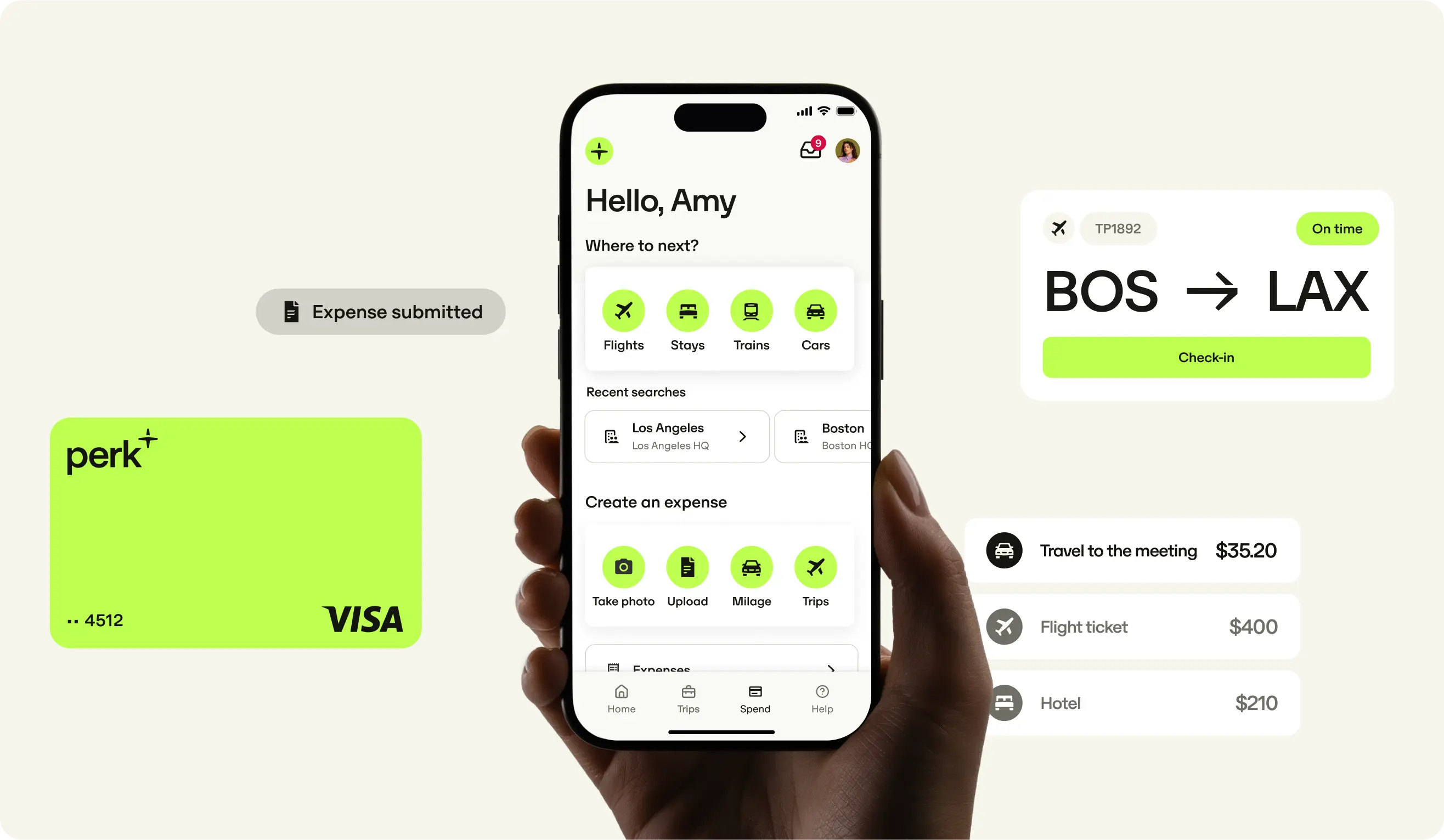
Perk is an AI-powered travel and spend platform for companies that want global travel booking, policy controls, expenses, invoices, and payments connected in one place. It is particularly well suited to international teams that want a consumer-grade self-service experience without handing finance a new layer of shadow work.
Employees can book flights, hotels, rail, and car rentals through Perk while seeing policy guidance at the point of booking. Approvals run in the background, travel data stays centralized, and bookings can flow into expense workflows instead of being recreated manually after the trip. That gives teams autonomy while helping the company maintain governance across offices, departments, and entities.
Perk also works well for companies deciding between a TMC and a self-service platform. Routine travel can be booked independently, but travelers still have access to 24/7 customer support when a trip needs expert help. That hybrid model avoids forcing employees through an agent for every straightforward trip while ensuring they are not left alone during a late-night disruption.
Key features:
FlexiTravel: Cancel eligible trips up to two hours before departure and receive an 80% refund as travel credit
Green Trip: Track and offset travel emissions
Perk Events: Manage group and event travel alongside everyday trips
Perk Cards: Corporate cards with up to 1% cashback on eligible plans and no foreign exchange fees
AI for spend management: Receipt extraction, transaction matching, and automated reconciliation
VAT recovery: VAT-ready invoices in the UK, Spain, and Germany
Medical and baggage insurance: Add trip protection during booking through battleface
VIP Experience: Concierge support for executive travelers
Duty of care: Real-time traveler tracking, risk alerts, and emergency support
Travel reporting: Centralized visibility into bookings, spend, compliance, cancellations, and recoverable VAT
Pricing (as of September 2026):
Three Travel plans are available for North America:
Starter: Free ($0/month) + 5% per booking: global inventory, 1 travel policy, core reporting
Premium (most popular): $99/month + 3% per booking: 10 travel policies, SSO, HR integrations, advanced reporting, budget tracking for up to 5 budgets
Pro: $299/month + 3% per booking: unlimited policies, custom integrations, custom reporting, unlimited budgets
For Europe, Travel & Spend combined plans are priced per user per month:
Premium: From $11/user/month: 4 legal entities, standard expense workflow, Perk Card with 0.5% cashback, dedicated account manager
Pro: from $13/user/month: unlimited entities, custom workflows, all ERP connectors, OpenAPI, Perk Card with 1% cashback
Spend-only plans start at $13/user/month (Premium) and $15/user/month (Pro).
No additional charges for customer care, account management, or implementation.
Add-ons (FlexiTravel, Green Trip, Duty of Care, insurance) are available at extra cost.
Review ratings (as of September 2026):
G2: 4.6/5 – based on 2,140 reviews
Capterra: 4.7/5 – based on 425 reviews
Good to know:
For global businesses, Perk’s travel inventory works internationally, including rail and low-cost carrier content that matters for European programs. Its combination of self-service booking, configurable travel policies, 24/7 human support, and multi-entity spend controls makes it a strong option for companies that need international consistency without a heavyweight enterprise rollout.
Navan (formerly TripActions)
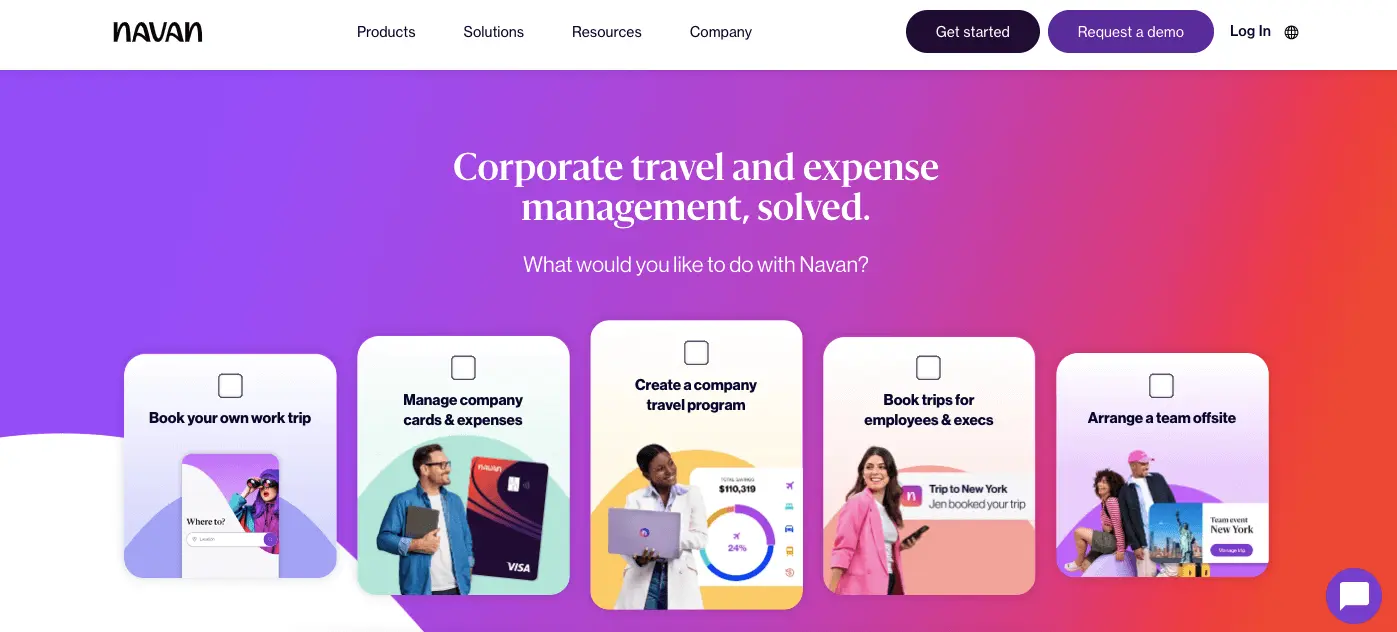
Navan is an established travel and expense platform for companies that want travel, cards, and expense management in a single proprietary system. Its self-service booking experience and integrated expense tooling make it a relevant option for mid-market and enterprise teams.
Key features:
Self-service booking for flights, hotels, cars, and trains with real-time inventory
Automated expense management with receipt capture and reconciliation
Group travel management
Regional inventory and local language support
Configurable travel and spend policies with automated approvals
Travel program reporting and analytics
24/7 customer support
Pricing (as of September 2026):
Navan publishes pricing at navan.com/pricing.
Business Travel: Free, with revenue generated through supplier commissions
Business Expense: Free for the first five monthly expensing users, then $15 per user per month
Enterprise: Custom pricing for teams of 300 or more
Review ratings (as of September 2026):
G2: 4.7/5, based on 9,297 reviews
Capterra: 4.6/5, based on 213 reviews
Good to know:
Navan’s expense management system is proprietary. That can be a benefit for companies that want one standardized system, but it is a significant consideration if your finance team already uses an expense tool it wants to keep. Review the full cost model, card requirements, and integration options before committing.
TravelBank

TravelBank is a mobile-first travel and expense platform that suits teams whose travelers manage most of their trips from their phones. It combines booking, expense reporting, card support, and analytics in one application.
Key features:
Travel booking and expense management in one app
Mobile-first interface
Corporate and personal card support
Travel data analytics and reporting
Integrations with cards and payment systems
Premium Insights dashboards
Annual rebate for eligible US Bank commercial card holders
Pricing (as of September 2026):
TravelBank uses modular pricing. Details are available at travelbank.com/all-in-one-pricing-package.
All-in-One: From $25 per user per month for travel, expense, and card reconciliation
Travel Management: Available as a separate package
Expense Management: Available as a separate package
Annual plans: From approximately $2,000 per year
Review ratings (as of September 2026):
G2: 4.5/5, based on 382 reviews
Capterra: 4.7/5, based on 254 reviews
Best for large enterprises
Large enterprises need more than a booking tool. They need durable controls across entities and markets, audit-ready data, deep integrations, tailored approval workflows, and the ability to manage a global program without losing local relevance.
These providers are typically better suited to organizations with complex procurement processes, established finance systems, and the internal resources to support a longer implementation.
SAP Concur

SAP Concur is best suited to large organizations that already operate in the SAP ecosystem or need extensive expense, invoice, audit, and enterprise resource planning integration. Its depth is valuable for complex global programs, especially where finance and compliance requirements take priority.
Key features:
Travel booking and expense management in one platform
Broad third-party integration options
Detailed expense tracking and reporting
Compliance and audit capabilities
Native SAP ERP integration
Automated policy checks and receipt capture
Pricing (as of September 2026):
Concur Expense Standard: Approximately $9 per user per month
Concur Expense Professional: Custom quote
Concur Travel and Expense: Custom quote
Implementation, integration, and premium support are commonly priced separately. That means the listed subscription price is only one part of the total cost of ownership.
Review ratings (as of September 2026):
G2: 4.0/5, based on 7,193 reviews
Capterra: 4.3/5, based on 2,261 reviews
Good to know:
Concur is a serious contender for large multinational companies with established SAP workflows, sophisticated approval chains, and detailed global compliance requirements. It is less suited to companies that need a fast rollout or a lightweight, intuitive booking experience without substantial administration.
American Express Global Business Travel (Amex GBT) — including Egencia

Amex GBT is a major global TMC with solutions spanning the mid-market through to multinational enterprise. Its scale, managed service model, and global support footprint make it a strong option for companies with complex international programs, high travel volume, or a need for agent-led service.
Amex GBT acquired Egencia from Expedia Group in 2021 and completed its acquisition of CWT in September 2025. The group now covers a broad range of travel programs, from online booking through Egencia to high-touch enterprise travel management.
What’s new in 2026:
Egencia introduced an updated platform in early 2026, including:
Conversational AI for booking and trip management
AI-assisted flight and hotel search
Near real-time Concur Expense integration for bookings and receipts
Simplified search and multi-fare flight displays
Egencia, best for mid-market businesses:
Online booking with Expedia Group inventory
VAT recovery and reimbursement tools
Duty of care and risk management
Traveler wellbeing support and integrated policies
Automated traveler communications
Amex GBT, best for multinationals:
Risk alerts and direct traveler communications during disruptions
Pre-negotiated supplier programs
Travel program management and strategic consulting
Global support across multiple markets
Pricing:
Egencia uses transaction-based or custom pricing. Amex GBT enterprise pricing is fully customized and depends on program scope, travel volume, service model, and regional requirements.
Review ratings (as of September 2026):
Egencia on G2: 4.5/5, based on 928 reviews
Egencia on Capterra: 3.8/5, based on 56 reviews
Amex GBT enterprise: No single consolidated review score
Good to know:
Amex GBT is among the strongest choices for companies that need a traditional global TMC relationship, including strategic support and agent assistance for complex international travel. Ask how the provider will support each major region, how its service model works after the CWT acquisition, and which booking and expense tools will be standard for your program.
BCD Travel

BCD Travel is a global TMC with offices in 109 countries, making it a relevant option for organizations that need a managed travel program across multiple regions. It serves both smaller organizations and large multinationals, although its managed service model is particularly relevant for complex enterprise programs.
Key features:
Cytric Easy for Microsoft Teams: Book flights, hotels, rail, and car rental from Microsoft Teams
TripSource: A travel portal for booking, reporting, and traveler communications
API access for custom integrations
Carbon offsetting and sustainable aviation fuel options within supported booking flows
Services for SMEs and enterprise programs
Pricing:
Pricing is customized based on company size, program design, travel volume, and service requirements.
Review ratings (as of September 2026):
G2: No data available
Capterra: No data available
Good to know:
BCD is a sensible shortlist choice for global organizations that need a managed TMC model, broad international presence, and support for complex integrations. Since public review data is limited, request references from companies with a similar travel footprint, industry, and technology environment.
Best traditional travel management agencies
Traditional travel management agencies are best for companies that need dedicated agents, strategic program management, and high-touch help with complex trips. They are particularly valuable in specialist sectors, for executive travel, for group movements, and where disruptions can carry a high operational cost.
A self-service platform is usually the better fit when most travel is predictable and employees value speed. A TMC is often the stronger choice when multi-city international trips, visa-sensitive itineraries, specialist travel, or personalized service are routine. Many companies now choose a hybrid model: self-service for everyday booking, backed by human experts for exceptions.
CWT (now part of Amex GBT)
CWT is a long-standing travel management company with expertise in specialist sectors and complex global programs. It became part of Amex GBT in September 2025, although both brands continue to operate independently while integration progresses.
Key features:
Web and mobile travel tools
Sector expertise in pharma, biotech, media, and energy
Risk management and duty of care services
Dedicated travel agents for complex itineraries
Pricing:
Custom enterprise pricing based on the travel program and service requirements.
Review ratings (as of September 2026):
G2: No data available
Capterra: No data available
Good to know:
CWT is a relevant choice when your travel program depends on experienced agents and specialist industry knowledge. For companies comparing it with a self-service platform, the key question is whether that level of managed service will be used frequently enough to justify the added program complexity and cost.
FCM Travel
FCM Travel combines a global TMC model with booking technology and local service. It is a strong candidate for companies that want a managed travel partner but need flexibility around their online booking and expense technology.
Key features:
Sam AI assistant: Conversational support for booking, trip changes, and travel questions
Risk intelligence from Crisis24 and SHERPA
Integration options with Concur, Deem, Cytric, and FCM’s own online booking tool
More than 100 reports for travel program visibility
One-click approvals across booking channels and markets
Local teams in major cities
Pricing:
Custom pricing based on team size, travel volume, countries supported, and the required service model.
Review ratings (as of September 2026):
G2: 5.0/5, based on one review
Capterra: No data available
Good to know:
FCM is worth considering for international companies that need local expertise and account management while retaining freedom over their booking and expense stack. Review its transaction fees and ask for a clear cost model based on your actual booking, change, and cancellation patterns.
CTM Travel (Corporate Travel Management)

CTM Travel is a full-service TMC that also supports events and leisure travel. It can suit companies that want one partner for travel program management, traveler support, and event logistics.
Key features:
CTM Portal: Central access to planning, approvals, in-trip tracking, and reporting
Lightning OBT: Online booking with approvals
Fare Forecaster for date-based fare comparisons
Real-time risk feeds and traveler alerts
Corporate event management
Planned AI-assisted booking and Microsoft Teams and Outlook integrations
Pricing:
Custom pricing based on the company’s program requirements.
Review ratings (as of September 2026):
G2: No data available
Capterra: No data available
Good to know:
CTM is most relevant for teams that need a service-led TMC with travel technology included. As with other providers that have limited public reviews, direct references are important. Ask about the booking experience in your key markets, after-hours support, implementation, and the exact features included in the commercial proposal.
Side-by-side comparison
The table below gives a high-level view of the companies covered in this guide. Egencia is grouped with Amex GBT following its 2021 acquisition, while CWT joined Amex GBT in September 2025. Ratings are from G2 and Capterra as of September 2026.
How to choose the right travel management company
Choose based on the reality of your travel program, not just the provider’s feature list. The most important question is whether the solution can support your travelers and finance teams across every office without creating extra manual work.
How big is your team?
Team size matters, but travel complexity matters more. Smaller and growing companies often benefit from self-service platforms such as Perk, Navan, and TravelBank because they can launch quickly and automate routine work without a lengthy implementation.
Large enterprises with many legal entities, strict controls, and established enterprise systems may need SAP Concur, Amex GBT, BCD Travel, FCM Travel, or CTM Travel. That said, a company with international offices does not automatically need a traditional TMC. If most trips are straightforward, a modern platform with global inventory, policy controls, and human support may deliver better adoption and lower operational overhead.
Do you need expenses too, or just travel?
Travel and expenses should connect if finance is spending too much time on reconciliations, missing receipts, and reimbursement follow-up. A joined-up workflow means booking data becomes part of the expense process automatically, which reduces manual entry and gives finance cleaner data at month-end.
Perk, Navan, and TravelBank all offer travel and expense capabilities. Perk also supports companies that want to bring travel and spend together without forcing a full replacement of their existing expense process. Its expense management solution and corporate cards can help connect booking, payment, receipt capture, and reconciliation.
If you already use an expense system that works well, integration flexibility should be a core requirement. The goal is not simply to consolidate tools. It is to remove the duplicate work that happens when travel, payments, and expenses live in separate systems.
How much support do your travelers need?
Choose a traditional TMC when human service is central to your program. Companies with frequent multi-city international travel, executive itineraries, specialist industry requirements, or travel to higher-risk destinations may value dedicated agents and account managers.
Choose a self-service platform when travelers mostly take standard point-to-point trips and need to book quickly within policy. The strongest platforms combine employee autonomy with always-on assistance, which is often the practical middle ground. Perk, for example, gives travelers self-service booking alongside 24/7 travel assistance and duty of care tools for disruptions and emergencies.
Where are your travelers going?
International coverage is about more than the number of countries a provider serves. The best corporate travel solution for international offices gives travelers relevant local inventory while giving the company one consolidated view of travel spend, policy compliance, and traveler risk.
Evaluate the provider in the regions where your people actually travel. That means checking regional airlines, rail content, accommodation choice, payment methods, currencies, language support, local tax requirements, and response times across time zones.
Perk is particularly strong for companies with European travel needs, including rail content and VAT-ready invoices in the UK, Spain, and Germany. Perk’s global corporate travel solution supports centralized management for distributed teams while allowing policies and controls to reflect local needs. Amex GBT, BCD Travel, FCM Travel, and CTM Travel are established options for larger managed programs that need broad international support.
For global travel policies, set one clear company standard, then adapt budgets, approval rules, and preferred travel options by market. The policy should be visible in the booking flow, not buried in a document that employees have to interpret on their own. Automated travel policies make that possible by applying rules before a booking is confirmed.
What's the real cost?
The lowest advertised subscription price rarely tells you the full cost. Compare booking fees, transaction fees, implementation, integrations, support tiers, change fees, account management, card requirements, and the internal admin time needed to keep the program running.
Perk’s Starter plan is free with a per-booking fee, while its North American Premium and Pro travel plans start at $99 and $299 per month. Navan’s travel product is available without a subscription, but expense functionality is priced separately. TravelBank starts at $25 per user per month. SAP Concur’s standard expense pricing starts at about $9 per user per month, while travel, expense, and enterprise implementations are typically custom priced.
The most effective way to optimize travel costs is to look beyond fares. Global companies save when they reduce booking leakage, enforce policy before purchase, recover eligible VAT, reconcile expenses faster, and recover value from canceled travel. Read more about ways to save money on travel for work before comparing providers on headline price alone.
What do other users say?
Reviews can reveal how a platform performs after implementation, particularly around ease of use, customer support, expense workflows, and reporting. Review volume matters as much as the headline score.
Navan and SAP Concur have large review samples. Perk also has substantial review coverage across G2 and Capterra. BCD, CWT, FCM, and CTM have less public review data, so build customer references into your evaluation and ask to speak with organizations that resemble yours in size, geography, and travel complexity.
Finding the right fit
The right travel solution depends on how your company actually travels. A fast-growing international company with straightforward trips may get the best result from a self-service platform that combines global inventory, automated policies, integrated expenses, and 24/7 human support. A large, highly regulated multinational with complex itineraries and a mature procurement model may need the managed service depth of a global TMC.
For many companies, the best answer is not a strict choice between a TMC and a self-service platform. It is a hybrid approach that gives employees the speed to book routine travel themselves while providing expert support for complex trips, disruptions, and exceptions.
Perk is built for that balance. It brings travel, expenses, invoices, events, and payments into one platform, helping companies remove the shadow work that builds up around travel administration. Employees get on with their trips. Finance gets control and visibility. Everyone gets more time back for real work.
Frequently asked questions
- A travel management company helps organizations manage travel for work, including booking, travel policies, spend reporting, traveler support, and duty of care. Traditional TMCs usually provide dedicated agents and account management, while modern platforms automate routine booking and policy enforcement.Many companies now use a hybrid model. Employees self-book straightforward trips, then use human support for complex itineraries, cancellations, and emergencies.
- A regular online booking tool helps a person reserve a flight or hotel. A travel management company or platform adds company-level controls, including policy enforcement, approvals, centralized invoicing, spend reporting, traveler tracking, and support.That distinction matters because travel programs fail when bookings happen outside the system. Without centralized data, finance teams chase receipts, managers cannot see spend in real time, and the company cannot reliably support travelers during disruptions.
- Start with the basics: pricing transparency, ease of use, what's included in customer support, and how well it integrates with your existing tools. Then think about your specific needs. Do you need expense management? Strong EMEA coverage? Agent support for complex trips? The right answer depends on your travel program.
- Some do, some don't. Perk includes 24/7 support on all plans at no extra cost. Navan also includes support. SAP Concur and many traditional TMCs have tiered support models where premium access costs more. Always clarify before you sign.
- It's your company's legal and ethical responsibility to look after employees while they're traveling for work. In practice, that means knowing where your travelers are, being able to reach them quickly in an emergency, and keeping them informed about any risks or disruptions. Most TMCs offer duty of care tools—some are better than others.
- Choose a self-service platform when most trips are routine and your priority is fast booking, traveler autonomy, automated policies, and transparent administration. Choose a TMC when travel is complex, international, high volume, or dependent on dedicated agent expertise.The strongest option for many companies is a platform that supports self-service booking but includes 24/7 human support. This gives employees a simple experience for routine trips while ensuring help is available when travel becomes complicated.

Simpler, smarter business travel: Book, manage and report all in one place.
Written by